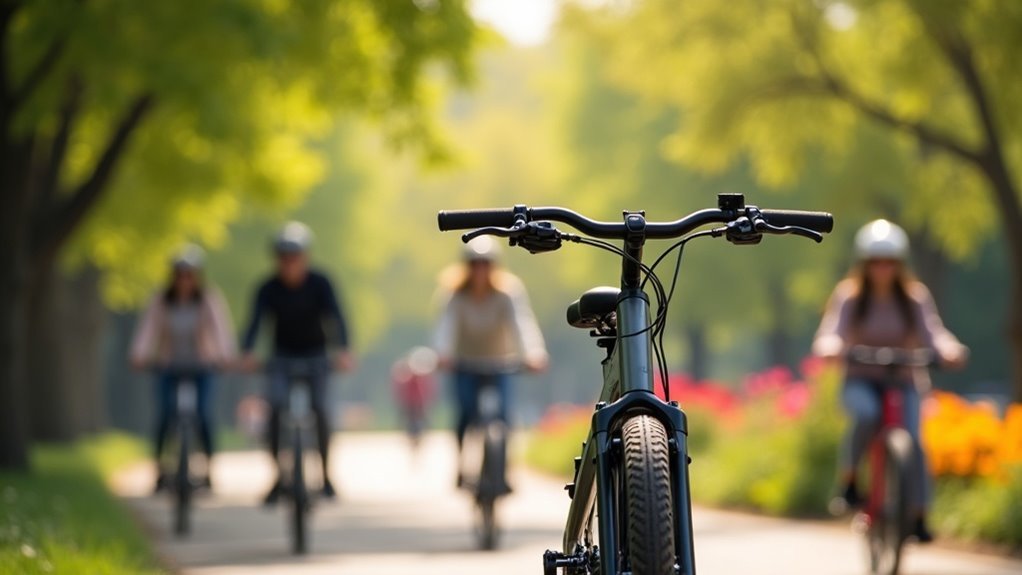
Only Class 2 e-bikes allow throttle use for acceleration, making them a convenient choice for users who may not want to pedal constantly. In contrast, Class 1 and Class 3 e-bikes require pedaling to engage the motor and don’t permit throttle operation. Class 3 e-bikes, in addition, have a higher top speed of 28 mph but max out on throttle engagement at 20 mph. Explore the nuances of e-bike regulations and safety requirements to guarantee compliance in your area.
Key Takeaways
- Class 2 e-bikes allow throttle use for acceleration without pedaling, with a max speed of 20 mph.
- Class 1 e-bikes do not permit throttle use; they require pedaling for motor engagement.
- Class 3 e-bikes restrict throttle use to a maximum speed of 20 mph, emphasizing pedal assist.
- Local regulations impact throttle use; check specific state laws for compliance.
- States like California and Oregon allow throttle use on Class 2 e-bikes, with varying helmet requirements for Class 3.
Understanding E-Bike Classes
When you explore the world of e-bikes, it’s essential to understand the different classes that define their capabilities.
E-bike classifications include Class 1, Class 2, and Class 3 e-bikes.
Understanding e-bike classifications is crucial, as they encompass Class 1, Class 2, and Class 3 models.
Class 1 e-bikes utilize pedal assist only, engaging the motor solely when you pedal, with a top speed of 20 mph.
Class 2 e-bikes, however, feature throttle use, allowing you to accelerate without pedaling, also capped at 20 mph.
Class 3 e-bikes can reach speeds up to 28 mph with pedal assist, but their throttle is limited to 20 mph.
Always check local regulations and electric bike laws for compliance.
Class 2 E-Bikes: The Throttle Advantage
Class 2 e-bikes stand out for their unique throttle advantage, allowing you to accelerate without pedaling. This feature offers an effortless riding experience, particularly beneficial for individuals with limited mobility or injuries.
With a maximum speed capped at 20 mph, Class 2 e-bikes guarantee safe riding conditions. Most models come equipped with pedal assist, enhancing versatility for various riding scenarios.
Additionally, in many states, helmet requirements may not apply, increasing accessibility for a broader audience. Understanding these electric bike regulations can empower you to choose a Class 2 e-bike that best meets your needs and preferences.
Class 1 and Class 3 E-Bikes: No Throttle Allowed
While many riders appreciate the convenience of throttle use in Class 2 e-bikes, it’s important to understand that Class 1 and Class 3 e-bikes operate under different rules.
Here are key points to contemplate:
- Class 1 electric bikes require pedal-assist, engaging motor assistance only when pedaling.
- Class 3 e-bikes also don’t allow throttle use but support speeds up to 28 mph.
- Both classes promote physical activity, emphasizing pedaling for motor engagement.
- Riders of Class 3 must be 17+ and wear helmets, reflecting local laws prioritizing safety at higher speeds.
E-Bike Regulations by State
As e-bike popularity surges, understanding the varying regulations by state becomes essential for riders. Class 2 e-bikes allow throttle use, making them accessible for many, while Class 3 e-bikes often face restrictions. Below is a summary of regulations across different states:
| State | Class 2 Regulations | Class 3 Regulations |
|---|---|---|
| California | Throttle allowed | Helmet required, local rules |
| Oregon | Throttle allowed | No throttle, 750W limit |
| Alabama | Motor-driven cycle laws | Class M license required |
| Alaska | Motor-driven cycle laws | Class M license required |
Stay informed to guarantee compliance with local rules.
Safety and Compliance Considerations
Understanding safety and compliance considerations is essential for e-bike riders, especially given the diverse regulations that vary by state. Here are key points to keep in mind:
Safety and compliance are crucial for e-bike riders, as regulations differ significantly by state.
- Class 2 e-bikes allow throttle use without pedaling, making them versatile for riders needing assistance.
- Class 3 e-bikes may include throttles but are typically limited to 20 mph for safety.
- Local laws can restrict throttle use, especially on specific bike paths.
- Helmet laws differ; Class 3 riders in California must wear helmets, while Class 2 riders face no age restrictions.
Staying informed guarantees compliance with safety regulations.