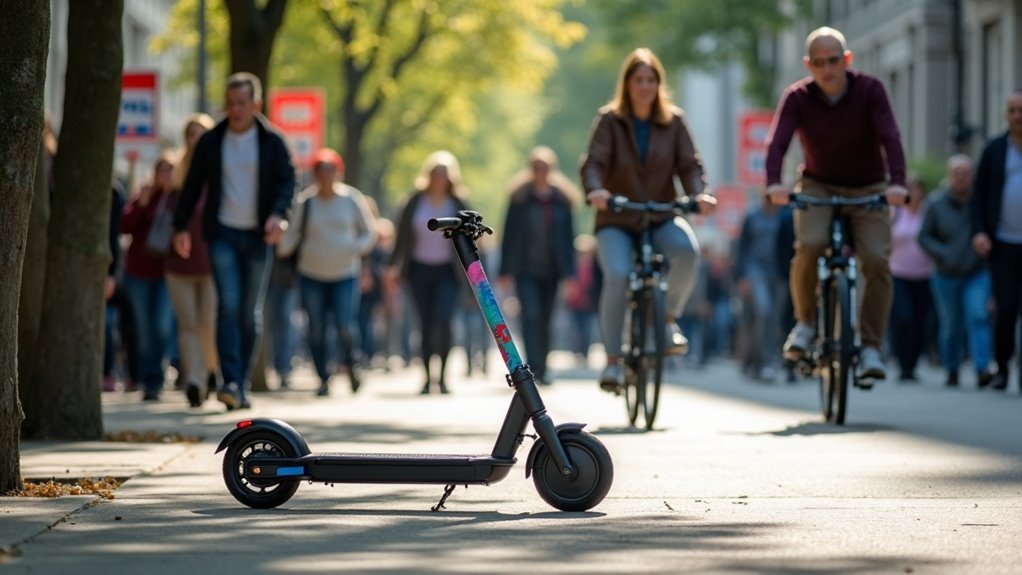
Cities restrict e-scooters on sidewalks to prioritize pedestrian safety. With two-thirds of e-scooter incidents happening in these areas, vulnerable groups like children and the elderly face greater risks. Inadequate sidewalk infrastructure, such as uneven surfaces and congestion, exacerbates these dangers. By limiting e-scooter use on sidewalks, cities aim to protect foot traffic and reduce injuries. Understanding the specific regulations and best practices can help you navigate these rules effectively and guarantee safety for everyone involved.
Key Takeaways
- Cities restrict e-scooters on sidewalks to prioritize pedestrian safety and reduce injury risks, especially for vulnerable groups like children and older adults.
- Sidewalks are primarily designed for foot traffic; allowing e-scooters can create hazardous conditions and increase conflict between riders and pedestrians.
- Inadequate sidewalk infrastructure, such as uneven surfaces and obstacles, poses significant dangers for both e-scooter riders and pedestrians.
- Local ordinances often enforce no-sidewalk policies to enhance safety in high-traffic areas and minimize congestion and accidents.
- Compliance with regulations helps protect foot traffic and promotes responsible e-scooter use in urban environments.
The Importance of Pedestrian Safety
Pedestrian safety is essential in urban environments, especially as e-scooter usage rises.
With sidewalks primarily intended for foot traffic, the influx of e-scooters greatly increases injury risks among vulnerable groups, like children and older adults. Data reveals that two-thirds of traffic incidents involving e-scooters occur on shared sidewalks, highlighting the dangers of sidewalk riding.
The rise of e-scooters on sidewalks poses significant risks to vulnerable pedestrians, particularly children and older adults.
Many cities enforce scooter sidewalk laws to reduce accidents, as pedestrian surfaces can’t accommodate e-scooter speed and weight. Low-speed collisions can still harm both riders and pedestrians, making it imperative to prioritize pedestrian safety.
Compliance with regulations, including bans on sidewalk riding, protects foot traffic.
Challenges of Sidewalk Infrastructure
As e-scooter usage rises, inadequate space allocation on sidewalks poses significant safety concerns for pedestrians.
You’ll notice that uneven surfaces and obstacles create hazards for both riders and walkers, increasing the likelihood of accidents.
This congestion complicates navigation, particularly in crowded urban areas, prompting cities to reconsider sidewalk infrastructure.
Inadequate Space Allocation
While sidewalks are meant for foot traffic, the surge in electric scooter usage is exposing serious flaws in urban infrastructure.
Many sidewalks lack the adequate space for both pedestrian traffic and e-scooters, creating safety hazards. Uneven surfaces and obstacles can make it difficult for scooter riders to navigate, increasing the risk of accidents.
In crowded areas, scooters obstruct pedestrian movement, leading to conflicts. Without designated lanes for electric scooters on sidewalks, local governments often resort to restrictions to prioritize safety.
Addressing these infrastructure challenges is essential to guarantee that both pedestrians and scooter riders can coexist without compromising safety.
Pedestrian Safety Concerns
Given the increasing presence of e-scooters on sidewalks, safety concerns for pedestrians have surged to the forefront of urban planning discussions.
Sidewalks, designed primarily for foot traffic, become hazardous with e-scooter use, particularly for vulnerable groups like older adults and children.
Studies show that most serious injuries occur on sidewalks, where uneven surfaces can lead to sudden stops or falls.
Additionally, unpredictable scooter movements can startle pedestrians, elevating collision risks in crowded areas.
Consequently, cities enforce scooter laws to prioritize pedestrian safety and mitigate the growing accident statistics linked to e-scooter usage, ensuring safer urban environments for everyone.
State-by-State Regulations on Sidewalk Riding
When it comes to riding e-scooters on sidewalks, regulations vary considerably from state to state.
In some places, like California, you’ll face fines for sidewalk riding, while other states, such as Alabama and Arizona, allow it under certain guidelines.
It’s essential for you to stay updated on local laws, as municipalities can impose stricter rules than state regulations.
Varying Local Regulations
As electric scooters gain popularity, the rules surrounding sidewalk riding differ markedly from one city to another, making it essential for riders to be aware of local regulations. Some areas prohibit sidewalk riding to protect pedestrians, while others allow it under specific conditions.
| State | Sidewalk Riding Regulations |
|---|---|
| California | Prohibited to prioritize safety |
| Oregon | Limited use for parking/crossing |
| Alabama | Allowed with safety guidelines |
Violating these traffic laws can lead to fines ranging from $50 to $200, so staying informed about your city’s rules is vital for safe riding.
Prohibited Areas Explained
Understanding the specific prohibited areas for e-scooter riding is essential for any rider traversing city streets. Many cities implement restrictions on sidewalk riding to prioritize pedestrian safety.
- California generally bans e-scooters on sidewalks, with local exceptions.
- Oregon permits sidewalk use only for parking or street crossings.
- Texas has state restrictions, but cities like Austin may enforce stricter rules.
- Violating these laws can lead to fines between $50 and $200.
- Always check local regulations to guarantee compliance.
Local Ordinances and Their Enforcement
Although state laws may allow e-scooter riding on sidewalks, many cities implement stricter local ordinances to improve pedestrian safety.
These local laws often include no-sidewalk policies and are enforced through signage indicating where riding is allowed or restricted. Enforcement varies considerably; some cities impose hefty fines ranging from $50 to $200 for violations.
Local no-sidewalk policies are enforced with signage, and violations can lead to fines between $50 and $200.
Additionally, local ordinances may address specific areas, such as high-traffic zones or tourist-heavy spots, to guarantee scooter safety and accessibility.
Staying informed about these regulations is essential, as they can change quickly, impacting your riding experience and safety on sidewalks.
Best Practices for Riding in Pedestrian Areas
Riding an e-scooter in pedestrian areas requires awareness and consideration for those around you.
To guarantee safety for both scooter riders and pedestrians, follow these best practices:
- Maintain a low speed to allow for quick reactions.
- Always yield to pedestrians and give them the right-of-way.
- Use audible signals to notify pedestrians when approaching.
- In crowded areas, dismount and walk your scooter.
- Opt for designated bike lanes and paths whenever possible.
Consequences of Violating Sidewalk Riding Laws
Failing to abide by sidewalk riding laws can lead to significant consequences for e-scooter users.
Non-compliance with sidewalk riding laws can result in serious penalties for e-scooter users.
For instance, violating sidewalk riding laws might result in fines ranging from $50 to $200, depending on local regulations.
Moreover, rental companies often restrict access for users who accumulate multiple violations.
If you’re involved in an accident while riding on sidewalks, you could be held liable for resulting injuries.
Non-compliance can also attract increased scrutiny from city authorities, leading to harsher enforcement measures.
In addition, you may face additional penalties, such as higher insurance costs or legal fees, making it essential to follow the rules.