Motor wattage ratings don’t tell the complete story of e-bike performance. Factors like torque, voltage architecture, and controller tuning greatly influence how an e-bike functions in real-world situations. For example, higher torque improves acceleration and hill climbing, while higher voltage systems provide sustained power and reduce heat. A well-tuned controller can make a lower wattage bike outperform a higher wattage one. Understanding these aspects helps you grasp true performance potential more fully.
Key Takeaways
- Peak wattage reflects short bursts of power, not sustained performance, making it misleading for overall capability evaluation.
- Torque significantly influences acceleration and responsiveness, often overshadowing wattage in real-world riding scenarios.
- Higher voltage systems improve efficiency and reduce voltage sag, enhancing sustained power output and performance consistency.
- Controller tuning affects how effectively power is delivered, meaning a well-tuned lower wattage system can outperform poorly tuned higher wattage systems.
- Real-world experiences often reveal that wattage alone does not correlate with performance, especially on inclines where torque is crucial.
The Limitations of Wattage Ratings
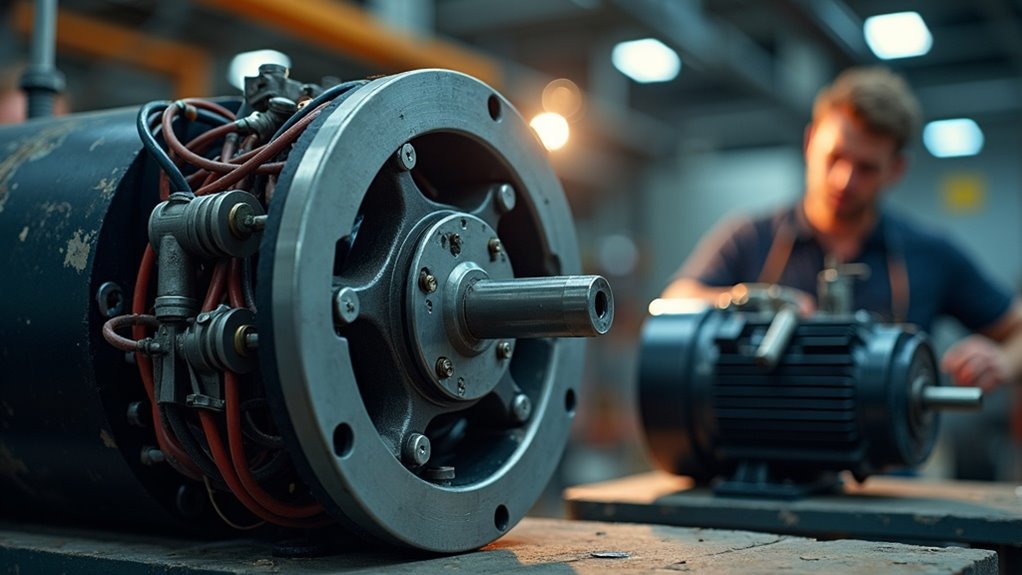
When you’re shopping for motors, it’s important to understand the limitations of wattage ratings. Manufacturers often label motors with varying wattages—250, 500, or 1000 watts—leading to confusion about performance expectations.
Remember, peak wattage reflects short bursts, while continuous ratings show sustained power. A well-tuned 750W system might outperform a poorly tuned 1000W system.
High torque is vital for tasks like climbing hills, providing better acceleration and responsiveness than wattage alone suggests. Factors like voltage architecture and controller settings impact actual performance, making wattage an inadequate measure when considering hub motors or mid-drive systems.
Focus on torque output for real-world effectiveness.
Understanding Torque and Its Impact
Torque is an essential factor in determining an e-bike’s performance, especially when it comes to acceleration and climbing ability. Higher torque translates to better responsiveness and powerful launches, making your ride more enjoyable. Consider this comparison:
| E-Bike Model | Torque (Nm) | Watt Rating |
|---|---|---|
| Ariel Rider X-Class | 110–132 | 3000 |
| Competitor A | 70 | 3500 |
| Competitor B | 90 | 4000 |
| Competitor C | 100 | 2500 |
Understanding torque helps you appreciate how it affects your e-bike’s real-world performance beyond just watt ratings.
The Role of Voltage Architecture
Understanding voltage architecture is essential for maximizing your e-bike’s performance and efficiency. Higher voltage systems, like 60V setups, provide greater power output without needing more current, which enhances your motor’s efficiency.
These systems maintain consistent power levels, reducing voltage sag as the battery drains, leading to sustained performance during climbs or heavy loads. Additionally, they generate less heat, boosting the longevity of your motor and battery.
With a higher voltage architecture, you’ll notice improved throttle response and better hill climbing capabilities, allowing you to navigate challenging terrain with ease while ensuring reliable performance every ride.
Importance of Controller Tuning
Maximizing your e-bike’s performance goes beyond just voltage architecture; controller tuning plays a pivotal role in how effectively your motor delivers power.
A well-tuned controller optimizes amp limits and thermal management, ensuring your motor operates within its ideal range. This leads to improved motor performance and energy efficiency, allowing a 750W e-bike to outshine a poorly tuned 1000W model.
For instance, the Ariel Rider X-Class 60V demonstrates how precise tuning maintains torque, enhancing your riding experiences, especially on hills.
Real-World Riding Experiences and Performance
Many riders find that real-world performance often defies expectations set by wattage ratings alone.
While a 1000W e-bike might boast impressive numbers, it may struggle on inclines compared to a well-designed 750W system with high torque.
Torque, not just motor wattage, plays an essential role in your riding experiences.
Torque is crucial for an enjoyable ride, often outweighing motor wattage in performance.
E-bikes with higher voltage systems provide sustained power, ensuring consistent performance as the battery drains.
Effective controller tuning can make a well-tuned 750W system outperform a poorly tuned 1000W system.
Ultimately, your e-bike’s performance hinges on torque, sustained power, and the quality of its e-bike system, not just peak wattage.